From idea to impact: Alliance grantees prepare for community-rooted sustainability
Funded by the MERCK Foundation, and jointly led by VCU Massey Comprehensive Cancer Center and the VCU Center on Health Advancement, the focus of the Alliance for Equity in Cancer Care (the Alliance), alongside its eight grantees – American Society of Clinical Oncology (ASCO) Conquer Cancer, Boston Medical Center, Case Comprehensive Cancer Center, Mary Bird Perkins Cancer Center, Memorial Sloan Kettering Cancer Center, National Comprehensive Cancer Network (NCCN), RWJBarnabas Health, University of Kentucky Markey Cancer Center – has shifted from launching community-rooted programs to supporting sustainable patient-centered workflows.
During its fourth annual meeting on March 16, eight grantee sites serving vastly different patient populations convened in Richmond, Virginia, to celebrate the Alliance’s shared successes and discuss what it truly takes to reimagine and sustain equitable cancer care. This year’s theme of exploring community-rooted models in oncology set the stage for a strategic working session. At a time where programmatic funding is uncertain, the collaborative nature of the meeting served as a reminder of the important work being done across the country. As Robert A. Winn, MD, director of the Alliance put it, “Some things come and go, but equitable care has always marched us in a forward direction.”
Annual Meeting Recap
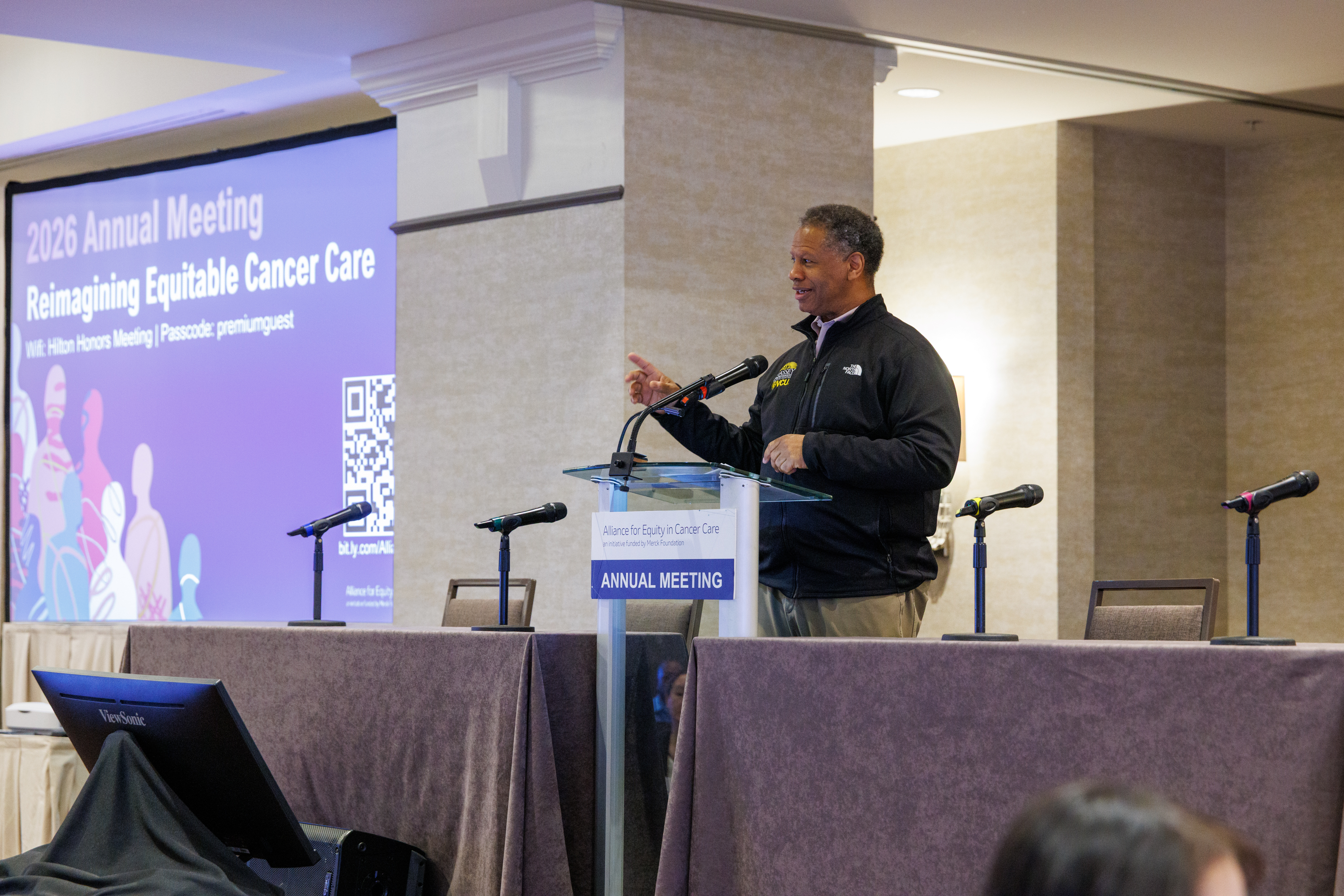 Dr. Winn at the fourth annual Alliance meeting
In his opening remarks, Winn spoke to the importance of knowing your role and your “Why” when working with cancer patients. While cancer care can be overwhelming and difficult at times, he reminded grantees that, “Sometimes forward progress is not always showy, it’s simply knowing what the assignment is and doing the work.” When speaking to sustainability, Winn energized the attendees by reminding them of their collective impact. “The Alliance has taken an idea and institutionalized it,” he said, referring to the dozens of organizational and systems-level changes that have occurred as a result of the initiative; ones that are improving practices across the care continuum. He closed out by asking what patients in frontier Montana have in common with those in inner-city New York, answering with, “Access to their care can be impeded by social drivers of health. That’s what we are tackling in this initiative; that’s our assignment.”
Dr. Winn at the fourth annual Alliance meeting
In his opening remarks, Winn spoke to the importance of knowing your role and your “Why” when working with cancer patients. While cancer care can be overwhelming and difficult at times, he reminded grantees that, “Sometimes forward progress is not always showy, it’s simply knowing what the assignment is and doing the work.” When speaking to sustainability, Winn energized the attendees by reminding them of their collective impact. “The Alliance has taken an idea and institutionalized it,” he said, referring to the dozens of organizational and systems-level changes that have occurred as a result of the initiative; ones that are improving practices across the care continuum. He closed out by asking what patients in frontier Montana have in common with those in inner-city New York, answering with, “Access to their care can be impeded by social drivers of health. That’s what we are tackling in this initiative; that’s our assignment.”
While the meeting didn’t have a traditional keynote speaker, two experts in the field filled that role. Allison Hirschorn, director of coverage and reimbursement at ASCO, kicked off the meeting with an overview of Principal Illness Navigation (PIN) billing, including reporting guidance and the crucial role these efforts play in sustainability. Hirschorn shared the latest reimbursement requirements for grantees to inform PIN billing at their respective organizations.
Martha Quinn, MPH, a qualitative evaluation and policy research expert at the University of Michigan, shared initial findings from the Alliance’s health system and policy change efforts. Now, with a systematic process in place to document and track this work, grantees are beginning to advance system and policy-level changes at their respective organizations.
In order to create cohesion between the eight programs, and to look at the different ways they are working, grantees were asked to analyze, refine and discuss the status of two models. The two models, adapted by the Alliance, included the Reach, Effectiveness, Adoption, Implementation, Maintenance (RE-AIM) Model, and the Alliance Business Model. Panel discussions for both groups gave insight into how the organizations fare in regards to the benchmarks set by the National Program Office, and will help determine the scalability of the models moving forward.
Sustainability in Numbers
With the help of patient navigators, institutional leaders and community partners, Alliance grantees were able to assess nearly 3,000 patients for social drivers of health and connect those in need with critical social support services. This data point not only reaffirms the necessity of accessible care, but also reminds grantees of the importance of a team. It takes a village to help a patient with cancer from diagnosis to treatment and through survivorship.
Throughout the duration of the initiative, over 50 abstracts, presentations, op-eds and peer-reviewed articles have been accepted or published. As the Alliance prepares for participation in future professional conferences and speaking engagements, they are asked to consider how what they built can be scaled and adopted more broadly. This is the question that will inform the work of the grantees moving forward.
Grantees know that community-rooted strategies and system-level changes are essential to the sustainability of this initiative. With one more year to go, they must continue to listen to their communities, garner long-term support from leadership, and ensure patients remain at the center of all decisions. With all of these in mind, the Alliance is confident that its eight grantees can keep the momentum going, and evolve as external factors change to serve even more vulnerable populations throughout the country.