Alliance RE-AIM Model: How Mary Bird Perkins Cancer Center is operationalizing ‘reach’ in cancer equity
 MBPCC Navigator assisting a patient (Photo by MBPCC)
This is the first in a series of blogs highlighting the Alliance for Equity in Cancer Care (Alliance) adaptation of the Reach, Effectiveness, Adoption, Implementation, Maintenance (RE-AIM) model. The model, introduced in 1999 by Glasgow, et al.,1 explains how organizations must measure five domains simultaneously “to determine the public health or population-based impact of a program or policy.” With input from grantee sites, the Alliance has established evidence-informed benchmarks to guide equity-focused cancer care coordination across each domain while addressing a critical gap in the field: the absence of standardized metrics for operationalizing and measuring equitable cancer care.2
Mary Bird Perkins Cancer Center (MBPCC) is Louisiana’s leading community cancer care organization, serving patients throughout the Gulf South. Since joining the Alliance in 2022, MBPCC has established a comprehensive navigation program from the ground up, with more than a dozen patient navigators supporting over 600 patients to date. As part of the Alliance, MBPCC’s focus population is predominantly African American (73%). Nearly 97% of patients receiving care at Mary Bird Perkins are from areas designated as medically underserved.
Notably, many MBPCC patients experience one or more social drivers of health (SDOH) barriers, such as financial strain (64% on Medicare/Medicaid or uninsured), unreliable transportation (24%), and food insecurity (23%). Patient Navigators at MBPCC have seen how these barriers can result in patients missing, delaying or completely stopping their care, which can in turn increase the risk of disease progression and cause worsened symptoms.
The barriers faced by patients at cancer centers make the RE-AIM Model particularly important. Identifying patients with barriers is only the first step. The challenge is creating systems that reliably connect patients to navigation and ensure that referrals result in meaningful engagement.
The Alliance RE-AIM Model
The Alliance RE-AIM Model helps organizations understand how to reach people most in need, establish effective approaches to equitable cancer care, adopt those approaches into daily practice, implement across care teams and systems, and maintain long-term improvements over time. The first RE-AIM domain – Reach – is defined by Glasgow et al.,1 as the “individual-level measure,” meaning the specific people who are affected by the policy or program.
Reach is more than simply counting how many patients receive navigation services.
 Nicole Honoré, M.Ed. (Photo by MBPCC)
It requires organizations to understand who is being reached, whether they are engaging patients facing the greatest barriers to care, and whether systems are designed to consistently connect patients with the support they need. MBPCC offers a strong example of how organizations can put this concept into practice.
Nicole Honoré, M.Ed. (Photo by MBPCC)
It requires organizations to understand who is being reached, whether they are engaging patients facing the greatest barriers to care, and whether systems are designed to consistently connect patients with the support they need. MBPCC offers a strong example of how organizations can put this concept into practice.
The Alliance identified three key functions to successfully reach its patient population:
- Integrating SDOH and psychosocial screenings into routine cancer care
- Connecting patients to support services through proactive referral processes
- Establishing accountability through ongoing monitoring and evaluation of REACH data points
MBPCC uses these functions to translate the Alliance benchmarks into complete coverage throughout patients care journeys. As Nicole Honoré, M.Ed., program director for the MBPCC Alliance team, highlights, “Reach helps us determine not only how many patients receive navigation support, but whether we are reaching the populations who face the greatest barriers to timely, equitable care.”
Measuring Reach: From Benchmarks to Practice
MBPCC’s experience demonstrates the value of pairing clearly defined benchmarks with systematic processes for monitoring performance.
Reach Metrics: Alliance RE-AIM Model
|
Metric |
Alliance Suggested Benchmark |
Site Outcome* |
|
Psychosocial Screening Completion |
≥ 90% |
98% |
|
SDOH Screening Completion |
≥ 90% |
98% |
|
Newly Diagnosed Patients Engaged by Navigation |
≥ 95% |
100% |
*Site outcomes reflect July 1, 2023–June 30, 2026 (n=623).
MBPCC exceeded each of the Alliance’s suggested Reach benchmarks during the reporting period. These results demonstrate the site’s ability to consistently screen patients and engage newly diagnosed patients with navigation services. At the same time, the Alliance’s equity-focused approach to Reach encourages an additional question: are the patients experiencing the greatest barriers to care being reached and supported?
This distinction is important. A program can achieve high overall Reach while still having opportunities to examine whether engagement is consistent across populations, levels of social needs, and degrees of barrier burden. For MBPCC, relying on its data and navigation infrastructure is vital to understand Reach across the diverse needs of the population it serves.
MBPCC’s Blueprint for Reach
MBPCC’s approach integrates technology, clinical workflows, patient engagement and accountability. Its Patient Navigation Workflow establishes a collaborative framework for incorporating navigation throughout the patient journey. This workflow is supported by clinician training, community outreach, and an active Community Advisory Board, which serves as a crucial link to the community and guides navigation efforts to ensure that services meet patient needs.
Key clinical partners include Baton Rouge General and Woman’s Hospital. These partnerships support culturally sensitive care and ensure patients have access to support services throughout their continuum of care.
MBPCC strategies for optimizing Reach include:
- Implement Proactive, Automatic Navigation Referral Systems
- Embedding automated diagnostic tools into the clinical workflow – specifically the NCCN Distress Thermometer; PHQ-2, a screening tool used to check for signs of depression; and the Health-Related Social Needs tool, a screener designed to help care teams find unmet social needs that affect a patient's health. These processes create opportunities to identify needs earlier and connect patients with appropriate support.
- Embed Screening into Standard Clinical Workflow
- Integrating SDOH and psychosocial screenings into routine care and automating referrals and reminders while continuously monitoring and evaluating data. This approach makes navigation part of routine care rather than an additional service patients must independently seek out.
- Leverage Multimodal Patient Engagement
- Integrating patient care teams, nurse navigators, and social workers at pivotal visits, such as initial consultations and chemotherapy teach sessions, ensures navigation begins alongside clinical care.
- Track Performance in Real Time & Ensure Accountability
- Logging all screening scores, referrals, and service fulfillments directly in the electronic medical record (EMR), establishing clear accountability across care teams. This infrastructure allows the organization to monitor performance in real time and hold care teams accountable.
Key Takeaways
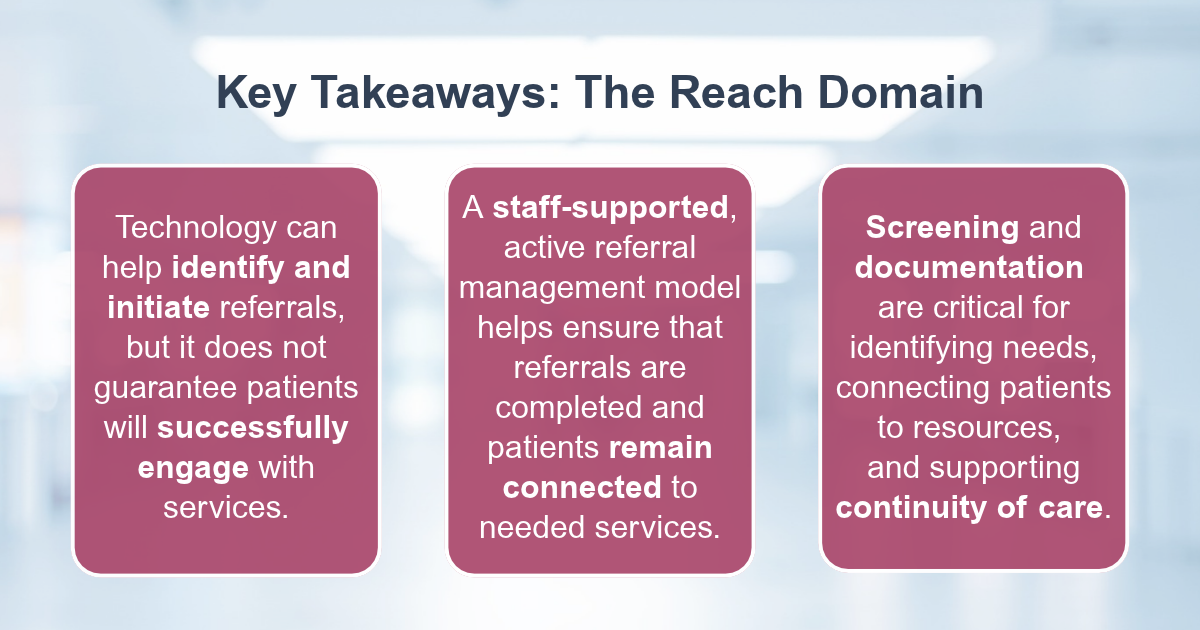
One of the most important lessons from MBPCC’s experience is that technology can help identify and initiate referrals, but it does not guarantee patients will successfully engage with services. MBPCC initially relied more heavily on electronic referrals. Over time, the team recognized that automated referrals could lead to patient drop-off. In response, MBPCC shifted toward a staff-supported, active referral management model. Rather than viewing the electronic referral as the endpoint, navigators and other staff help ensure that referrals are completed and patients remain connected to needed services. This experience highlights an important principle for equitable cancer care: efficient systems are not necessarily equitable systems. Automation can improve identification, tracking, and workflow efficiency, but human engagement remains critical for patients facing complex social and structural barriers.
Building leadership and clinical buy-in has also been essential. Staff must understand that screening and documentation are not simply administrative requirements. They are integral components of identifying needs, connecting patients to resources, and supporting continuity of care.
What Other Cancer Programs Can Learn
MBPCC’s experience offers several practical lessons for organizations seeking to strengthen Reach:
- Measure Reach rather than assume it. Clearly defined metrics make it possible to identify gaps and monitor progress over time.
- Build navigation into clinical workflows. Reaching patients consistently requires processes that are integrated into routine care rather than dependent on patient self-referrals.
- Use technology to support, not replace, human engagement. Automated screening and referrals can improve efficiency, but staff support may be necessary to ensure follow-through.
- Create accountability for closing the referral loop. Screening a patient for a need is only the beginning; organizations should also understand whether patients successfully connect with services.
- Look beyond overall participation rates. Equity-focused Reach should prompt organizations to examine whether patients experiencing the greatest barriers are being consistently identified and engaged.
- Use data to drive continuous improvement. Real-time monitoring can help clinical and navigation teams identify gaps and adapt workflows.
Looking Ahead
For MBPCC, operationalizing Reach has meant building navigation into the way cancer care is delivered—not simply adding navigation as a separate service. By combining systematic screening, proactive navigation, staff-supported referral management, patient engagement and real-time monitoring, MBPCC has developed a scalable approach for connecting patients with support throughout the cancer care journey.
The experience highlights that achieving a high level of Reach is an ongoing process. As MBPCC continues to engage patients at various stages of care and collaborate with local and national partners, it remains dedicated to identifying patients facing barriers to cancer care. The goal is to connect these patients with support and ensure they are not lost in the system. The MBPCC experience shows how the Alliance RE-AIM Model can move from a conceptual framework to a practical approach for measuring and improving equity in cancer care.
The next blog in this series will delve into how the University of Kentucky Markey Cancer Center plans to use the Implementation Domain.
References
- Glasgow, R. E., Vogt, T. M., & Boles, S. M. (1999). Evaluating the public health impact of health promotion interventions: The RE-AIM framework. American Journal of Public Health, 89(9), 1322–1327. https://doi.org/10.2105/AJPH.89.9.1322
- Wickland, E., Zhu, J., Casazza, K., Deng, X., Bush, B., Marcum, B., Wright, M. S., & Winn, R. A. (2026). Operationalizing equitable cancer care through system-level change. Journal of Oncology Navigation & Survivorship, 17(4). https://www.jons-online.com/issues/2026/july-2026-vol-17-no-4/operationalizing-equitable-cancer-care-through-system-level-change