Alliance RE-AIM Model: How the University of Kentucky Markey Cancer Center is using digital innovation for the ‘implementation’ of cancer navigation
This is part of a series of blogs highlighting the Alliance for Equity in Cancer Care (Alliance) adaptation of the Reach, Effectiveness, Adoption, Implementation, Maintenance (RE-AIM) model. The model, introduced in 1999 by Glasgow, et al.,1 explains how organizations must measure five domains simultaneously “to determine the public health or population-based impact of a program or policy.” With input from grantee sites, the Alliance has established evidence-informed benchmarks to guide equity-focused cancer care coordination across each domain while addressing a critical gap in the field: the absence of standardized metrics for operationalizing and measuring equitable cancer care.2
For patients undergoing cancer treatment in Kentucky, getting to appointments is often just one of many challenges. Transportation barriers, financial strain, food insecurity, and limited access to support services can disrupt treatment and place additional demands on patients and their families. These challenges are especially pronounced in rural Appalachian communities, where long distances and persistent poverty can make it harder to access care and community resources. At the University of Kentucky Markey Cancer Center (UKMCC), about 44% of patients live in rural Appalachian counties, and nearly one-quarter are enrolled in Medicaid. As patients' needs arise between clinical appointments, UKMCC began exploring how technology could build on existing patient navigation services and help care teams identify and address concerns before they become harder to manage.
Since joining the Alliance in 2022, UKMCC has advanced this work through its Comprehensive Connected Cancer Care (C4) Project, which brings together community-based oncology programs across Kentucky. At the center of the project is MyPath KY, a mobile app and companion navigation dashboard designed to improve communication between patients and care teams, connect patients with supportive resources, and strengthen care coordination. The project addresses a key limitation of traditional navigation approaches: identifying and addressing emerging needs often depends on direct patient contact via scheduled appointments and follow-up communication.
Developing a More Connected Approach to Cancer Navigation
Developing MyPath KY has required UKMCC to consider not only how technology could help patients communicate their needs, but also how the navigation team would use that information. Working with its Clinical Collaborators Committee and Patient Advocate Committee, UKMCC incorporated perspectives from patients, clinicians, and other stakeholders to help ensure the application would be practical for patients and fit within existing navigation services.
The result is a dynamic communications tool that offers patients connection to care teams and supportive care resources in real-time. Patients are introduced to MyPath KY during their initial visit by a navigator or social worker and are encouraged to complete regular assessments in the application using the National Comprehensive Cancer Network (NCCN) Distress Thermometer. Through these assessments, patients can report concerns related to barriers they may be facing. The application then provides personalized recommendations for community, statewide, and national resources, allowing patients to self-select support services and provide updates on whether assistance was received or is no longer needed.
While patients gain another way to communicate their needs and access resources, navigators gain greater visibility into concerns that might otherwise go unreported until the next patient encounter. Through the companion dashboard, care teams can review patient-reported concerns, monitor referral activity, and determine when additional assistance is needed.
The Alliance RE-AIM Model: Moving From Innovation to Implementation
The Alliance RE-AIM Model helps organizations understand how to reach people most in need, establish effective approaches to equitable cancer care, adopt those approaches into daily practice, implement across care teams and systems, and maintain long-term improvements over time. The Implementation Domain of the RE-AIM Model is defined as a program or policy being used across care teams as it was intended.1
For UKMCC, MyPath KY's success depends on more than how many patients use the application. Equally important is how the technology is integrated into navigation practices and whether it helps care teams identify patient needs sooner, coordinate referrals more efficiently, and provide timely support. This is where the Implementation Domain of the Alliance RE-AIM Model becomes particularly relevant.
The Implementation Domain focuses on how interventions are carried out in practice. For UKMCC, these measures help assess whether MyPath KY is making navigation more responsive and efficient, rather than simply expanding access to digital resources. The Alliance has identified three benchmarks to guide this evaluation:
|
Metric |
Alliance Suggested Benchmark |
|
Average Navigator Time per Patient Episode |
≥ 60 minutes of PIN services/month |
|
Time from Need Identification to Referral |
≤ 7 days |
|
Patients with Identified Psychosocial and/or SDOH Needs Addressed Upon Request |
≥ 75% |
As UKMCC continues integrating MyPath KY into its navigation services, these benchmarks will help the team assess how effectively patient-reported concerns are translated into referrals, follow-up, and supportive care. The findings will also inform ongoing improvements to navigation workflows and provide lessons for other cancer programs seeking to implement similar approaches.
UKMCC's Blueprint for Implementation
Although the MyPath KY application lets patients report concerns and receive resource recommendations between visits, putting this information into everyday practice depends on clear processes for reviewing patient needs, deciding when additional assistance is needed, and ensuring appropriate follow-up.
A particular focus has been strengthening the referral process. MyPath KY creates an opportunity to make those connections sooner, but UKMCC recognizes that recommending a resource does not guarantee a patient will receive assistance. Patients may still struggle to contact an organization, meet eligibility requirements, or access services, making continued navigator involvement essential.
To address these challenges, UKMCC worked with its patient navigator and Psych-Oncology Supervisor to review current processes and create a dashboard protocol for tracking patient needs and referral activity. The revised approach helps navigators identify referrals requiring additional attention, contact patients as needed, and document progress throughout the referral process. It has also prompted the team to clarify the responsibilities of non-clinical patient navigators and oncology social work navigators, so concerns are directed to staff with the appropriate expertise.
These changes reflect UKMCC's broader approach to implementation: technology supports navigators’ work and helps the team address patient needs more consistently.
Key Takeaways
UKMCC's experience has reinforced the importance of considering technology, staff responsibilities, and patient engagement together when introducing new navigation approaches.
-
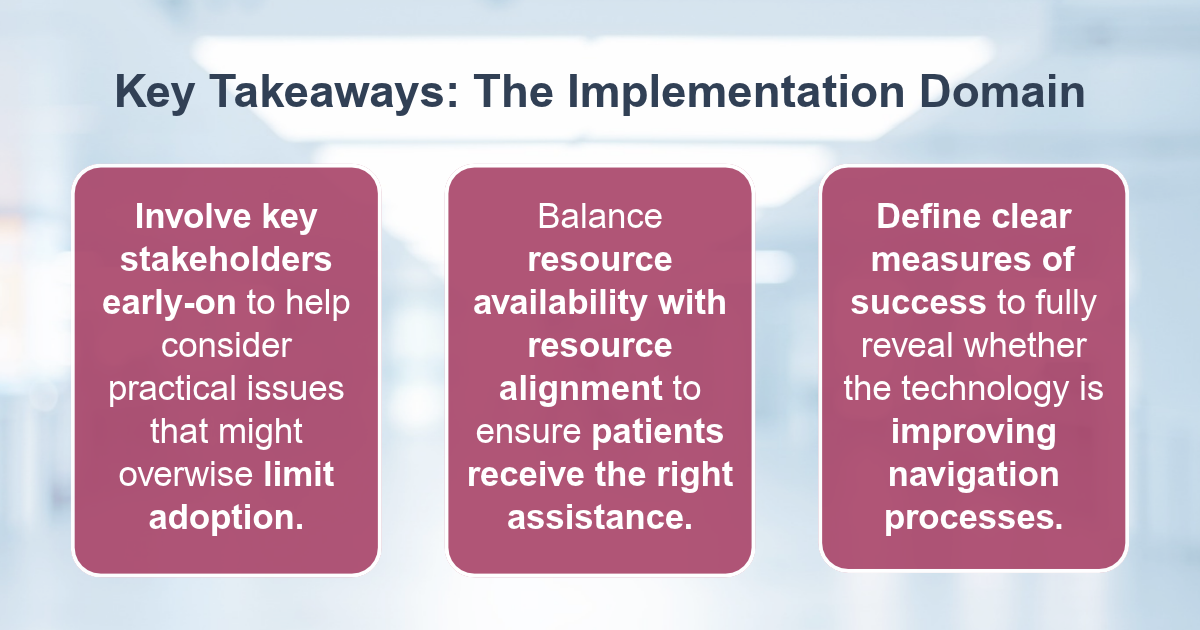
Engage with clinical leadership, navigators, and patient advocates early. Involving key stakeholders early-on throughout development has helped the team consider practical issues that might otherwise limit adoption, including how patients are introduced to the application, how reported concerns are reviewed, and who handles follow-up.
- Balance resource availability with resource alignment. The project has also highlighted the need to distinguish between making resources available and ensuring patients receive the right assistance. While MyPath KY can provide personalized recommendations, navigators remain responsible for helping patients address concerns that require further coordination or intervention.
- Define clear measures of success. Patient enrollment and application use show participation, but they do not fully reveal whether the technology improves navigation processes. By using the Alliance Implementation benchmarks, UKMCC can assess operational measures such as the time from identifying a need to initiating a referral, navigator time spent supporting patients, and the proportion of identified needs addressed upon request.
What Other Cancer Programs Can Learn
Although MyPath KY was developed in response to the needs of patients receiving care in Kentucky, UKMCC's implementation experience raises several considerations for cancer programs seeking to strengthen navigation services:
- Digital tools should be developed with a clear understanding of the people and processes they are intended to support. UKMCC's collaboration with patients, clinicians, and navigators illustrates the value of involving those who will use the technology in decisions about its design and integration into care.
- Organizations should consider how automation can complement, rather than replace, navigator responsibilities. Automated assessments and resource recommendations may make information available sooner, but patients with complex needs may still require individualized assistance, coordination across services, and continued follow-up.
- Referral management requires clearly assigned responsibilities and a method for tracking what happens after a resource is recommended. UKMCC's dashboard and revised navigation protocols provide a structure for monitoring patient needs and documenting referral activity, while patient self-reporting contributes information about whether services were received.
- Organizations need measures that extend beyond technology adoption. Understanding how frequently patients use an application is useful, but evaluating implementation also requires examining whether the intervention is being integrated into routine practice and whether the processes it supports are functioning as intended.
These lessons reflect a broader principle of the Alliance RE-AIM Model: successful implementation depends not only on introducing an intervention, but also on establishing the operational processes needed to deliver it consistently.
Looking Ahead
UKMCC is continuing to refine MyPath KY and explore opportunities to expand its use across cancer care settings.
 Katie Brown, MSSW
The team plans to enroll an additional 150 patients at UKMCC in Lexington and two partner hospitals–Appalachian Regional Healthcare in Hazard and Med Center Health in Bowling Green–to test the updated application. The team is also exploring how to incorporate nurse navigators into the dashboard workflow, extending coordination across additional care team members. These efforts will inform UKMCC's goal of integrating MyPath KY more broadly into cancer navigation services in 2027.
For Katie Brown, MSSW, UKMCC Psych-Oncology Supervisor, the potential to extend navigation support through technology is particularly meaningful. "I am excited to see how incorporating technology into our patient navigation work can help us reach more patients, improve access to psychosocial support, and ultimately increase the impact we can have in supporting patients through their journey."
As UKMCC continues this work, its experience offers an opportunity to better understand how to integrate digital tools into navigation services without losing the personal support patients depend on. The next phase of the project will help determine how these approaches perform across different care settings, how they affect navigator workflows, and whether they can be sustained as part of routine cancer care. Through its participation in the Alliance, UKMCC is contributing to a growing body of implementation knowledge that can help other cancer programs evaluate and strengthen the systems used to identify patient needs, coordinate supportive services, and follow referrals through to completion.
The next blog in this series will explore how Memorial Sloan Kettering Cancer Center is working to sustain its navigation program through the Maintenance Domain.
References
- Glasgow, R. E., Vogt, T. M., & Boles, S. M. (1999). Evaluating the public health impact of health promotion interventions: The RE-AIM framework. American Journal of Public Health, 89(9), 1322–1327.
- Wickland, E., Zhu, J., Casazza, K., Deng, X., Bush, B., Marcum, B., Wright, M. S., & Winn, R. A. (2026). Operationalizing equitable cancer care through system-level change. Journal of Oncology Navigation & Survivorship, 17(4).